

On a rainy December evening in 2006, a strange woman drew a picture of tempura shrimp into the bright orange notebook that I carried with me everywhere. We were on the train from Narita, Tokyo’s far-flung international airport, where I had just landed, via Detroit, from Ottawa. I was giving up on a job and my last semester of university to travel, though I hadn’t admitted that to anyone yet, including myself. This was my first international trip, and Tokyo was the first place I had ever been outside of Canada. The thought of not going back to Ottawa or to school was a thrilling, though distant, thrill, like lightning striking somewhere on the horizon.
It was getting dark outside when the woman drew the shrimp in my notebook. I was delirious from the red-eye flight, from exhaustion and excitement. The woman had approached me to practice her English and—upon finding out where I would be staying—was giving me food recommendations. She told me to go to a particular noodle shop and ask for the tempura shrimp. At least that’s what I think she was trying to say; the English she was practicing was limited, though her skill as a shrimp artist could not be questioned. Beneath the shrimp, she had drawn a map, and in the middle of the map she had written the name of the neighbourhood and circled it a few times for effect: Asakusa.
I hadn’t chosen Asakusa, exactly. A friend who was living in Japan at the time had helped me book a hostel, and that hostel—which I’ve written about in the past, with my temporary friends and the train ride into the city and the lit up vending machines through the steamy windows at each railroad crossing—was in the north of Tokyo, along the Sumida River, near the Asahi headquarters with its hilarious name (Asahi Group Head Office Super Dry Hall) and its enormous golden horn on the roof. I was only in Asakusa for 20 hours or so and had never really been anywhere, let alone somewhere so huge and confusing. I remember having sake. I remember watching people do martial arts along the misty river in the morning, looking calm and otherworldly. I remember Tommy Lee Jones’ face plastered on the side of all the vending machines, shelling cans of Boss Coffee. I remember walking around and taking pictures on my malfunctioning Pentax film camera until it was time to head to Haneda Airport and go south to Nagasaki. In my bewilderment, I failed to get the tempura, but also failed to notice a key feature of the Asakusa neighbourhood: the magnificent Senso-Ji temple.
In addition to being Tokyo’s oldest temple, Senso-Ji is one of its most significant and largest. The main temple gates are at either end of a long shopping street called Nakamise-dōri, hundreds of little shops offering shinto paraphernalia, rental costumes, cold drinks, magnets, ice cream, cooking supplies, heavily lacquered wooden tables, and so much incense. The outer gate is nicknamed the Thunder Gate and features a gigantic painted lantern. The inner gate Hōzōmon is 75 feet high and has huge bronze statues and more paper lanterns, and reveals a courtyard with the temple, a pagoda, incense bowls, and thousands of visitors. It’s a hard place to miss, really. It takes up half of a huge Tokyo district. And yet, in 2006, I had no idea it was there.
I’m thinking about how silly this is 20 years later, when standing in the shadow of the Thunder Gate in the morning heat of July, watching Steve McCurry watch stuff.
It’s the fourth day of our Tokyo photo workshop. I’d been in Asakusa for about half an hour, loitering in the air conditioning of a Starbucks, when I saw Steve and Eolo Perfido, his co-host for this Tokyo street photography workshop, arrive. I quickly went to join them, and before long Steve peeled off to stand on a corner in the shade alone. “This is what he does,” Eolo tells me. “He’s found something he likes. He’ll probably stand there all day.”
Soon, the rest of the workshop participants arrived, and Eolo gave us the morning briefing and sent us on our way. We’d have a few hours to shoot in the blistering heat before breaking for lunch. I set off up the walking street to scout, but found the scene mostly uninteresting. Most of the shops were shuttered and those that were open were not photogenic. I checked out the gates, the temple, the pagoda, but found them all to be visually dull. I saw an old man with a blue uniform and a cardboard box full of little slips of paper, and followed him.
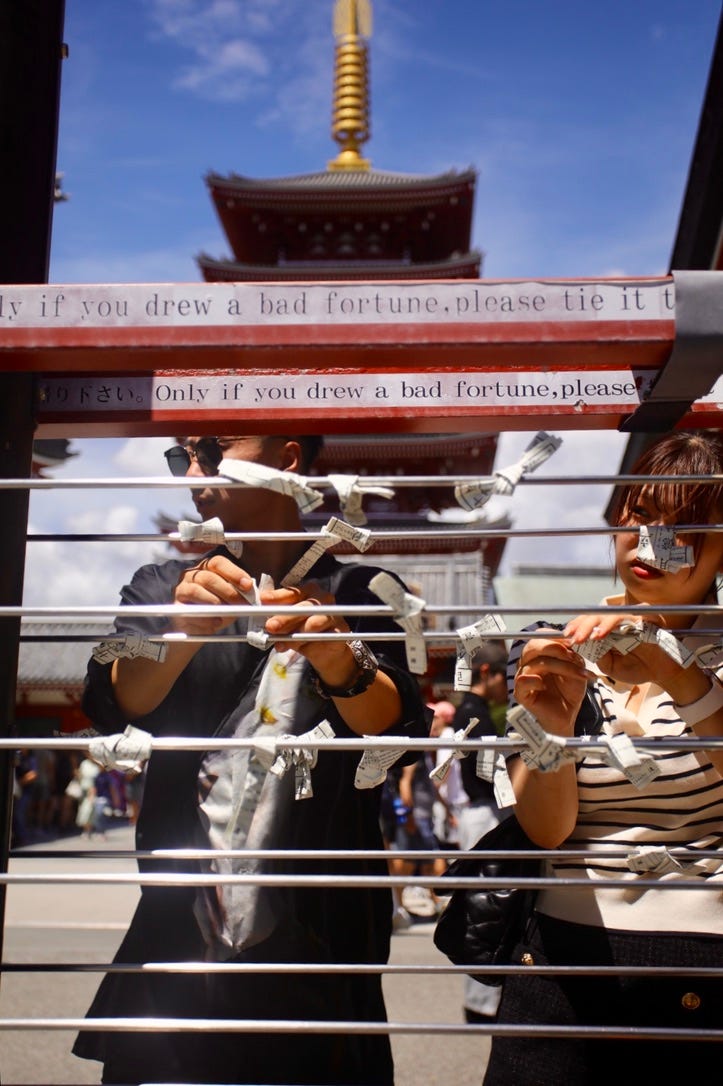
At temples in Japan, visitors can buy a fortune from a machine for 100 yen (about a dollar). These fortunes, in this era of Japan’s tourist boom, are available in Japanese, Chinese, and English. They’re written on long, thin pieces of paper so that they can be folded and tied onto racks around the temple grounds: good ones are taken inside the main temple where they can be accepted and blessed by the fates; bad ones are tied to different racks outside to be disposed of by the man in the blue uniform. I watched him as he unhooked rods from their racks and dumped dozens of bad fortunes into his cardboard box. I asked if he spoke English and he said “Little,” then I asked what he would do with the fortunes. “Fire,” he said. He put the box down and mimed lighting a match to make sure I understood. I loved the pragmatism of this, the certainty that a good fortune would be blessed, and the easy dismissal of a bad one, which would be collected by this temple janitor and ruthlessly disposed of.
I tried to take a few photos of him at work, but the background was a little boring and the light uneven. Instead, I found a young couple who were disposing of their bad fortune in front of the pagoda, and got one great shot. I saw people lighting incense and bowing and praying, and got some okay shots. I saw a guy who looked like a cowboy and took a sneaky shot of him that I love, even though it’s not technically that good. And then, feeling satisfied, I walked back to the main gate to find a coffee and some air conditioning.
Steve was still there, the same as when I had left him that morning. He had his camera around his neck, and despite wearing long pants and a long-sleeved shirt, didn’t seem to be bothered by the heat. (I admired this especially.) He was leaning against a wall, watching people go by. I watched him from across the street for a few minutes, and once or twice he made a subtle movement to lift his arm to reach for his camera, then hesitated and let them both drop to his side again. He swivelled his head around slowly. I was transfixed. What would happen? What was he waiting for? A few more minutes passed, and nothing happened. Nothing at all: he barely moved. So, I finished my coffee and went to a nearby kitchen supply district to buy a knife, leaving him standing there in his concentration.
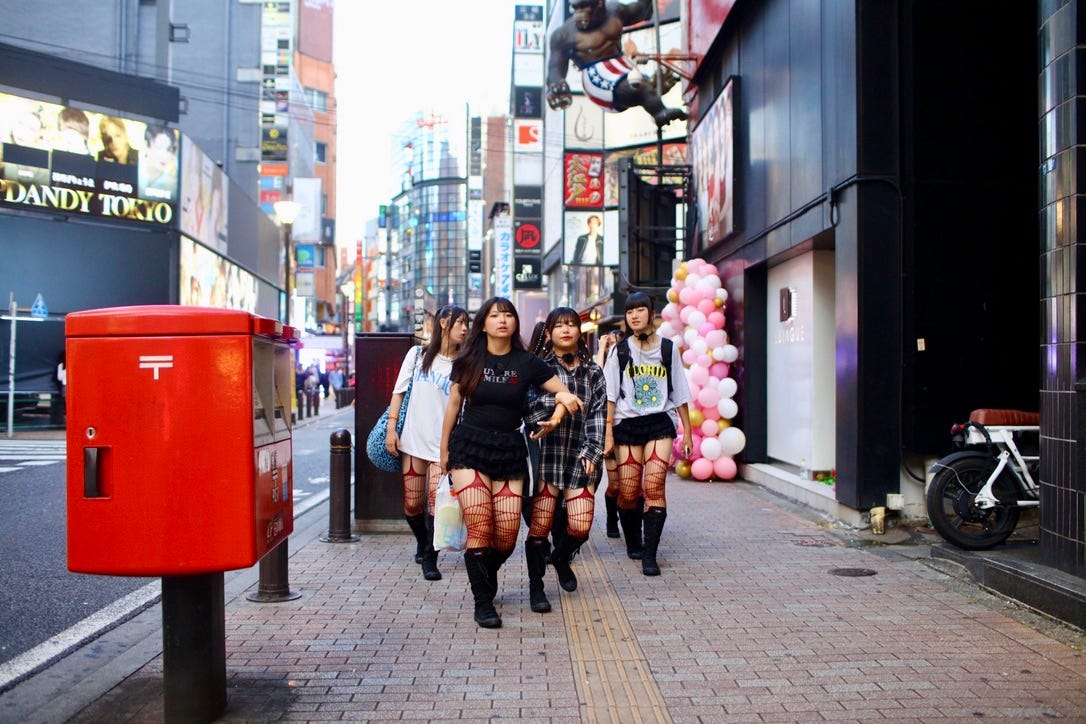
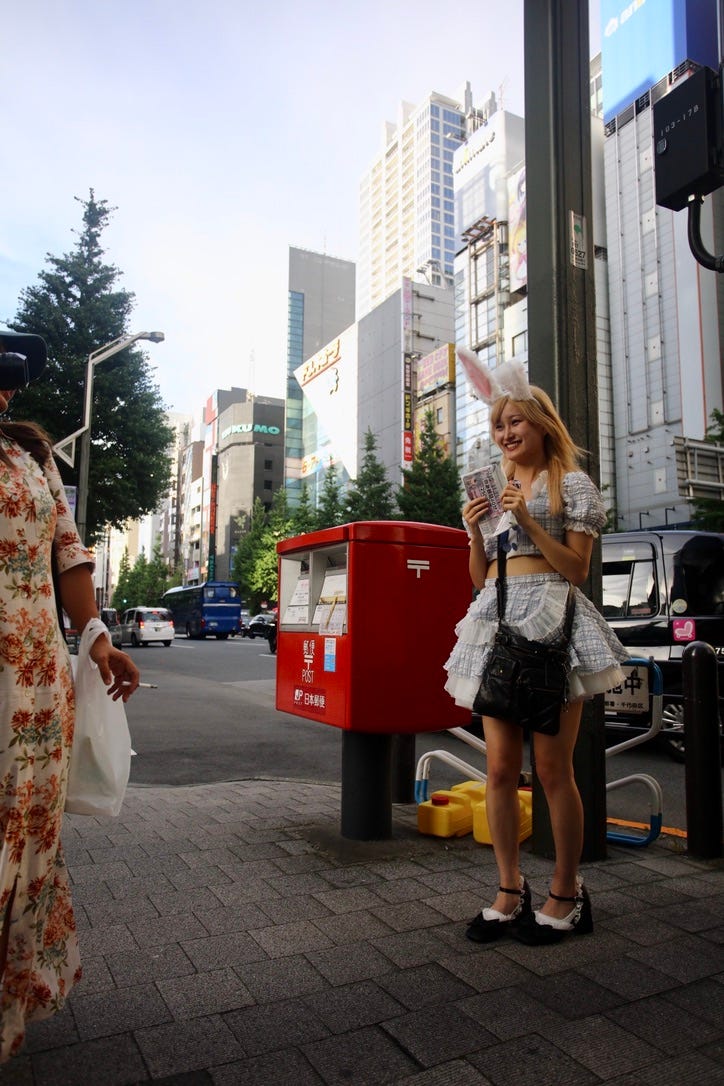
That afternoon, the group met up in Akihabara, a disreputable neighbourhood full of girly cafes and hobby shops, a kind of Mecca for horny nerds. The main street in Akihabara is lined with department stores filled with models from every JPRG video game and manga series, plus multi-story arcades and vast complexes of crane games. On the backstreets, young women dressed in the costumes of popular anime characters or generic male fantasy—French maids were very popular—stood in front of darkened entranceways holding glossy flyers to advertise the prices for an hour in their company (or the company of similarly dressed young women) within.
I had seen these girls in other parts of Tokyo, especially around the fringes of Shinjuku, in the days that I had spent here before the workshop began. Along one Shinjuku street, they are lined up ever night by the dozen, holding their laminated signs to advertise their bars. When I would try to take a photo, the signs doubled as a mask to hide their faces.
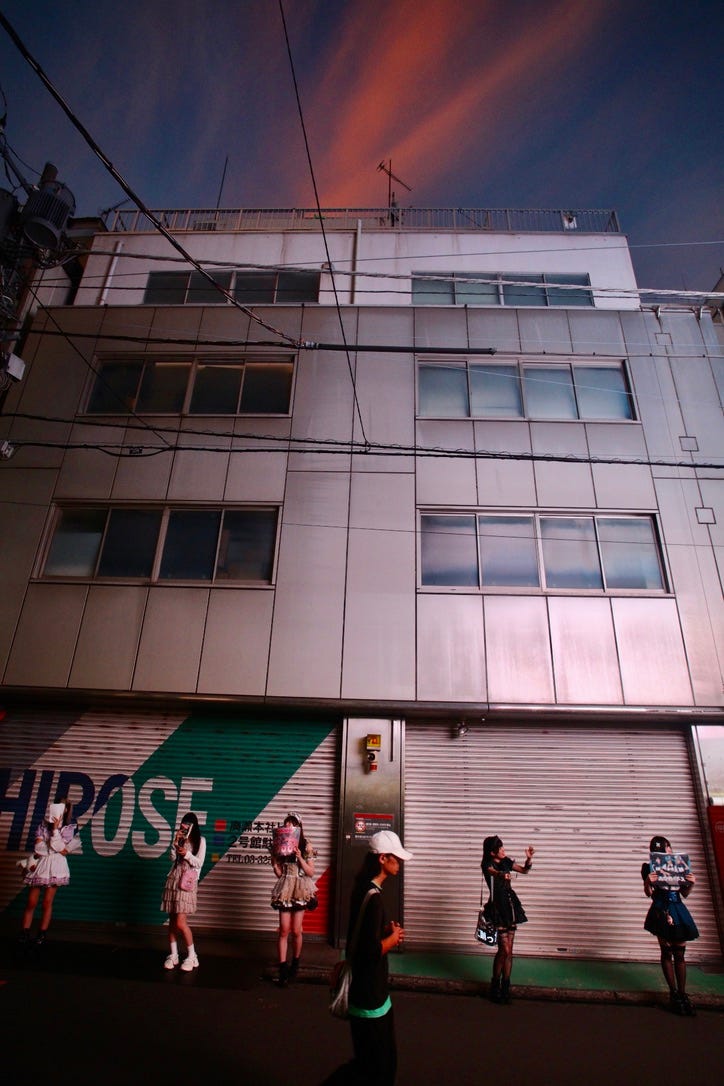
I felt too uncomfortable to go into one of these bars to see how they work, but did some Google- and Reddit-based research while in Tokyo to try to make sense of it. Information in English on this is dubious, but the gist seems to be this: patrons to these bars pay the advertised hourly rate to be allowed to drink surrounded by costumed waitresses. At the base rate, the customer sits in a general area of the cafe and is served by the girls, who make small talk with him. For a few hundred yen more, the customer can request more in-depth conversation, which is carried out by a small team of two or three girls. For even more money, he can have one-on-one time with a woman from across the bar. These prices are all listed on a menu, and men choose the level of interaction they want. Physical interaction is not listed on the menus, and I couldn’t find a definitive source on how close to brothels these bars are. Reddit users issued their standard authoritative-sounding hot takes like, “Of course relationships develop” and “The girls fall in love with these men,” but for every insistent claim that these were sex joints were five people saying “I’ve lived in Japan for 10 years and have never met anyone who had sex in a girly bar.” So, I guess, who knows? I probably should have gone in to decide for myself how gross this all was. Thankfully, there are better journalists who have tried to make this determination:
In his hilarious Amazon Prime show, Our Man in Japan, James May is confronted with the possibility of entering what he calls a “maid bar” in Osaka, bullied inward not by an alluring saleswoman but by his male Japanese guide, Yujiro. At the cafe in question, the girls are dressed like cats, and Yurijo goofily says, “You own cats, right?” May, visibly uncomfortable, offers a bulletproof refusal: “Yes, but these are not cats. They are teenage girls. It’s pervy.” A brief argument ensues in which May desperately calls for his fixer, a woman named Mai. “That’s a bit pervy, isn’t it?” he asks, pointing at the sign, always drawing out the world pervy to give it extra effect. “Yes, I believe so,” she says without hesitation. Yurijo, without missing a beat, clarifies: “Japan is a country of perverts. We are natural-born perverts.” Mai, embarrassed, suggests they go and have a look, and May says, “I am only agreeing to this because Mai is here.” The automatic door slides open and he yells, simply, in a moment of pure grief and discomfort: “You can’t do that!” then tries to leave. Yujiro, the natural-born pervert, pushes him back in. “Okay, okay, you take a seat,” says May. Once Yujiro has, May immediately flees the scene, charmingly saying, “Run for it. It IS pervy.” So there we have it.
My workshop group spends about 5 hours in Akihabra, prodding the perviness with our long lenses. There had been a brief downpour in the afternoon that did nothing to alleviate the summer heat, but instead turned the city stickier and slicker, leaving puddles everywhere and turning the streets shiny with moisture. Dark clouds still hung in patches of the sky, creating a breathtaking sunset. A hazy pink light filtered down through the grubby back alleys to cast a soft pretty glow on the frightened teen faces of the cafe workers, to reflect gently off their laminated cards.
Walking from the briefing near the metro station toward the first spot we’ll shoot, I fall into step beside Steve, who still doesn’t seem to be feeling the heat. He’s in a goofy mood, and involves himself in a silly showdown with a parking attendant who insists that he wait for a car to pass, Steve making the same exaggerated gestures as the attendant, both of them stern-faced until breaking out into huge smiles and laughs. “I love this country,” Steve says to me after his dance with the parking man. “Everyone is so serious until they’re not.”
As we stroll, we talk about the places he’s been, and I mentioned that I’d lived in Beirut for a year, long after he’d been stationed there to document the civil war. We talk about some of the journalists who had been there at the same time as him—Robert Fisk at the height of his powers, Terry Anderson (who was kidnapped for years by Hezbollah), Thomas Friedman before he became the windbag we know him as today—and Steve admits to not having had much overlap with them, partly by choice. He was more of a lone wolf, he says, which works better for his style of shooting anyway, but he had run-ins with some of those names. I mention how Fisk was still living there when I was there, though we didn’t run in the same circles, but how Anderson’s daughter was very active as an editor of the Daily Star when I lived there and had worked with my ex-wife, however tangentially. This bought me some kind of instant street cred, and Steve’s demeanour with me changed instantly. He asked with sudden interest about the kind of stories I wrote from Lebanon, and where else I’d reported on refugees, and the time between us passed easily. He told me that if I’m ever in Philly that we need to grab some beers, and I offered to show him around Toronto if he finds his way. He looks at me differently, and I feel like a kind of brotherhood has developed between us. It staggers me. When he wanders off to shoot, I stand in a kind of dumbfounded trance, in awe of what has just happened, not quite processing it. I send a long voice note to my best friend, telling her all about it, and I am giddy and in love with the world.
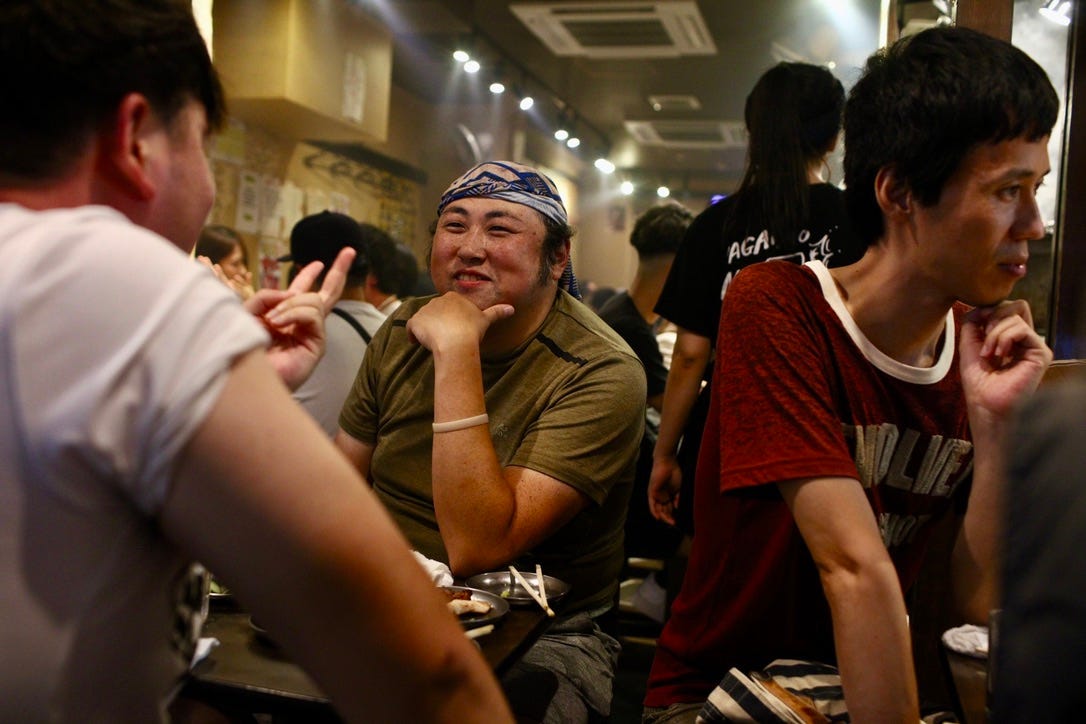
I wander the streets for a while, a bit too shy to take photos of the teenagers to get anything really good. I’m obsessed by the pink sky and the neon lights in the alley, and use my widest-angle lens to try to capture both. Some of the photos are fine, but most are a bit devoid of story. It’s funny how quickly I’ve come to see the world through the eyes of Steve and Eolo, and how self-critical I’ve become in a few short days. This is what it feels like to learn new things: to suddenly be able to see that you are not doing the thing you want to do, but to not quite know how to do the thing yet. My best shot once again comes from hanging around Ana, who has a natural ability to get people to lower their guards, and one of the cafe girls smiles and poses for us. The moment encourages me, and I set out for another hour of shooting on my own before my standard text to Ana and Caio to meet for dinner and beer. (I get my favourite photo of the day while waiting for a seat at an izakaya, when at my calmest, with stakes lowest. Another lesson.) Ana doesn’t respond to the dinner call, so Caio and I drink extra-large beers and have smoked tofu and chat until quite late, then head our separate ways on the subway platform, the night still dense with heat.
It’s around this time that the mutiny forms. Some of the other participants spin up a new WhatsApp group and add me. The topic of conversation is Eolo’s feedback on images that people are sending in the main WhatsApp group for the workshop. Eolo had offered to do a daily review of one photo per participant and encouraged us to share them publicly, in the group chat, in an attempt to erase shyness and foster a sense that everything here is work in progress. A handful of participants eagerly accepted this offer, and sent a few photos to the group at the end of each day of shooting (flagrantly disregarding the offer to review one photo per day), and sometime well after midnight each day Eolo would dutifully reply with a few sentences about each shot. The replies seemed a little formulaic and robotic to me, but he was writing 20 or so per day, providing decent feedback on composition and technique. As a casual observer, I was learning a lot from his replies: what looked to me to be a technically excellent photo would fail to move him, or he’d point out some imbalance in the colours of the background, a minor blur here or there, and I’d make a mental note to avoid these things in my photos, if possible.
Eolo’s feedback—the mutineers claim—is provided by AI, and they feel short-changed by that in a way that snowballs into a general feeling of having overpaid for this whole experience. “Where is the instruction?” they demand. “Where are the demonstrations of how to shoot?” All we are doing, they complain, is walking around alone in Japan, coming together at the end of the day to not get any feedback. They have a half-point, I think: how do we know if what we are doing is any good?
The next morning, our start is delayed by train disruptions, with half the group stuck on the line between Shinjuku and Harajuku, where we plan to shoot Takeshita Street. Those of us who arrived from other parts of the city or who got there early are desperately trying to find shade from Tokyo’s relentless sun, leaning on a wall beneath the lone tree outside the station or in the doorways of shops. Such is the discontent running through some of the group that this delay becomes another failure of the workshop, and so too is the heat, the sweat, the impending storm. We’ve reached a point where everything is a failure, everything an insult. I find this outlook irritating and distracting, so once the day begins I happily peel off from the group, away from Takeshita Street and its thousand hobby and comic shops, and head toward the charming alleys off Cat Street, where I’d earlier spotted cute cafes where I could sit and write. I drink iced coffee and a have a cheeky morning beer and work up the courage to ask the cafe owner if I can take his portrait, which is another of my favourite shots of the trip. This, I reflect, is huge progress: I would have never asked before, and would have tried to get some sneaky underhand shot that wouldn’t have been as good. At the very least, this workshop was teaching me to be courageous in minor ways.
I spent the early afternoon puttering around in nearby Omote-sando, eating cold noodles at a fancy place in the mall, browsing the MoMA Design Store and the Tokyo branch of Hay, feeling calm and happy in the air conditioning. I make my way on the train quite early to the evening shooting spot in Shimo-Kitazawa, a charming neighbourhood that I’d never been to, and browse its market stalls and record shops, where I ask interesting-looking people if I can take their photo, courage flowing, before joining the group in high spirits for our last night shoot. The sun is setting in Tokyo and the air is heavy and fragrant, the sky is turning orange and pink and I think there can be no better way to spend my time than this, idling away in a foreign capital with one of the greatest ever photographers. But I’m met with the sour faces of the dissatisfied, for whom now all of Tokyo is a kind of affront. They look at this charming little area and its beautiful fading light as though these are conspiring against them, as though the city and the sky are not prepared to teach us, as though the residents of Shimo-Kitazawa are their adversaries, uncooperative and unwilling to pose for us. When Eolo gives his brief, eyes roll. He notices, of course, but says nothing. Not yet, at least.
My photos from that session aren’t very interesting, and I don’t take many on the street. It’s a small area, so it’s hard to get too far from the group, from the bad vibes, so I give up on shooting for a while and just walk and observe. I see Eolo in his ambling way heading up a road toward the setting sun and follow behind. He doesn’t raise his camera. I see Steve parked at an intersection, camera in hand, and watch for a few minutes while his eyes scan the crowd of people walking toward him. Once or twice he raises his camera slowly to his eye and snaps a photo or two. I move around so that I’m on the street behind him, trying to understand what he sees here: a gently sloping street, a few old shops, dark wooden walls, some pretty light. I want to wait until he’s raised his camera again to try to guess which person has grabbed his attention, but he doesn’t. He waits a few minutes more and then ambles off toward the station, and I decide the day is done and head to find a shisha spot before meeting uncomplaining Caio at another excellent izakaya. Sitting on the uncomfortable half-benches of the restaurant, I get some cool photos of people who notice our cameras and want to pose. Caio has little interest in the mutiny and, like me, is just happy to be here, to be soaking it up. We share stories over a few sakes and head back to the city to prepare for the big day to come: a portfolio review with Steve McCurry.
I don’t have a portfolio. I tell this to Steve the day before the review and he says, “Just show me what you’ve taken in Tokyo.” I have a folder of about 500 photos that I’m editing on my iPad, and I try to pare that down to about 20 before meeting him, my absolute favourites and some near-misses. I think this is what you’re supposed to do, just show your best work and hope the expert agrees that it is great.
He texts me early in the afternoon and tells me to meet him in the lobby of his hotel. I joke that since I’m a writer, he can find me at the hotel bar. Instead, we meet in a non-descript hallway by the elevators, then walk around looking for a quiet place to sit. We find a kind of business centre where a group of flight attendants and pilots are huddled together and decide this will do. They look at us with idle curiosity. Do they know who he is, I wonder?
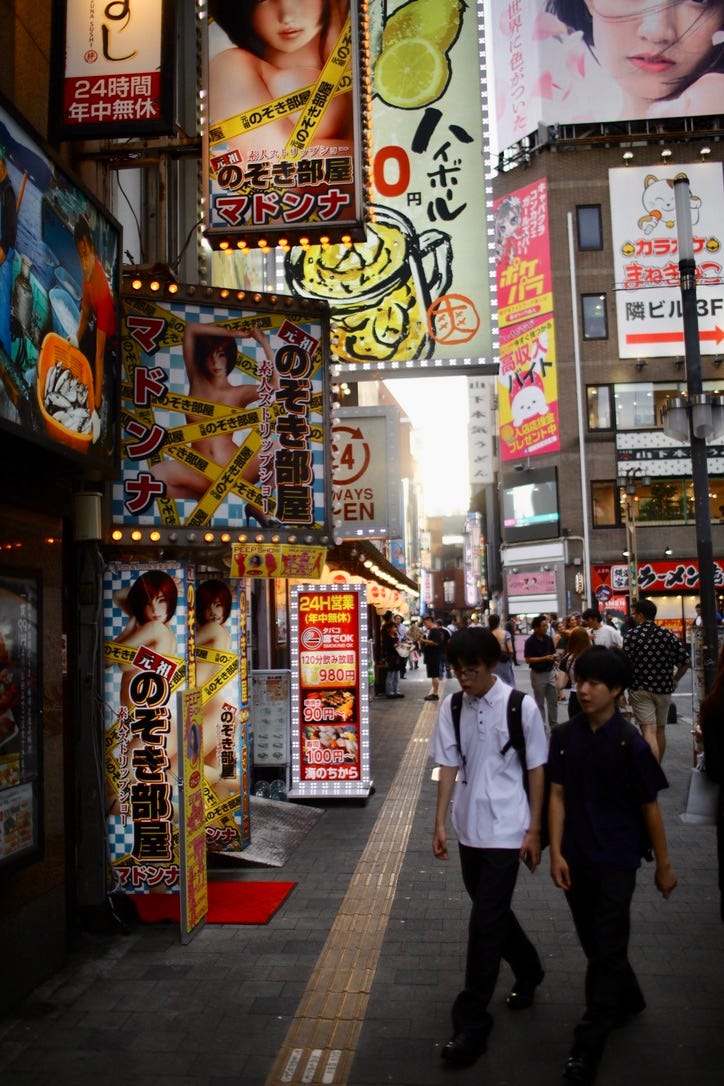
He pulls up a chair beside me and I open the iPad to my 20 carefully selected works, and he immediately says, “No, no, show me everything.” This is the first thing I learn that day. I go to the 500-photo folder and he seems much happier, then taps on the first one and flips through them at lightning pace, swipe swipe swipe. If something catches his eye, he stops and zooms in, then swipes past, then maybe comes back to look again. He does this a few times, never on photos I thought were that good, because he sees something I don’t. Every time he pauses I feel this burst of pride, and when he breezes past something I liked, a brief moment of shame. It’s fascinating, watching him look at my work, humbling and devastating and briefly rewarding. His favourite of my photos is of two kids walking in their school uniforms through a seedy street in Shinjuku, surrounded by signs showing half-naked women, the light from the setting sun piercing the shot. I liked but didn’t love this photo, but he takes a photo of it with his iPhone before moving on. He does this a couple of times, and each time it becomes more flattering. We spend about an hour together, him talking about what he likes about some of the photos but mostly just chatting about random topics, things we’ve seen elsewhere: this photo reminds him of something he saw in Korea, I tell him I lived in Korea, we talk about Afghanistan, about Philadelphia, Vancouver, Istanbul. He flips through my work with alarming speed, seeing everything. How quickly the mind of a lifelong professional processes what is before him.
As our hour draws to a close, he says, “Hey, do you want a book? I’ve got my animal book here.” I tell him I’d love one, and he says, “It’s like … 20 bucks.” I laugh, and he goes back to his room to grab a few copies. I can’t tell if he’s joking about the $20, because this is a $6,000 workshop, but decide he must be. I spend the 10 minutes that he’s gone laughing at our private joke. When he comes back, he signs a copy for me and repeats the price. I pay him in yen, still thinking it’s a joke, which maybe it was and maybe it wasn’t. Either way, I had a signed copy of Steve McCurry book and an evening to kill.
I walk around Shinjuku breaking a few of the rules I’ve spent the week learning. I forgo the wide-angle lenses I’ve been feeling frustrated by all week and lug around my heavy zoom lens, walking far from people I find interesting and turning to frame them from afar. I feel relaxed and happy, and get some of my favourite shots of the trip. Later that evening, the group meets around the Golden Gai to get drinks and to have Steve McCurry take a sweaty, nighttime portrait of each of us (which fuels the mutineers’ fire and deserves its own hilarious entry here—perhaps another time), before we gather in one of the tiny bars to celebrate the end of the workshop. The mood is light and playful and we drink too much beer and whisky, the workshop participants filling an entire microbar with laughter and the smoke of cheap cigarettes. I notice that a few other people have copies of Steve McCurry’s Animals.
The last day of the workshop finds the entire group hungover, clutching black coffees, seemingly content to be in the dark, air-conditioned conference room of a Shinjuku hotel looking at some of Eolo’s studio work. This last morning is another show-and-tell, with some photo editing tips mixed in. It’s a welcome break from the heat and a nice wrap up to an sweaty week of learning by doing and an intense contrast to the easy-come-easy-go nature of the shooting sessions. After about 5 minutes of Eolo’s presentation on the 2013 Pirelli calendar that Steve shot in Rio, we’re all reminded of the sheer expertise they both contain.
Eolo goes into lovely detail about his working relationship with Steve and shows some examples of how they mark up and edit photos together, something that may only interest the absolute die hard Photoshoppers out there, but which held our small group in rapt attention. He then did a studio photography tutorial to show us how to move around our subject once we’ve positioned them in perfect light. It was inspiring and informative, truly educational. Which proved a thorn in the sides of the still-discontented mutineers.
In a quiet moment, one of the Colombian photographers raised his hand and cleared his throat. “I’m sorry to say this,” he began, “but I honestly expected the whole week to be like this. Teaching. Demonstrations. Hands-on stuff like this. Instead, we just stood around in the heat, not really sure what we were going to be taking photos of. It was a lot of waiting, and not a lot of direction.”
Eolo laughed, quietly at first and then with more force. It didn’t do much to defuse the tension that now hung in the room. He leaned on his desk in his specific way, one leg extended and the other folded, and spoke calmly.
“Listen. I’ve worked with Steve McCurry for more than 20 years,” he said, then chuckled again. “And I have spent most of that time waiting without much direction. Sometimes, Steve will see something he likes—a wall, a bit of light, a funny contrast that only he can see—and he’ll camp there, perfectly still, waiting. For hours. Sometimes he’ll walk around for a bit, then come back to the spot. Sometimes he’ll take maybe one photo, sometimes—usually!—none. And we’ll come back to the same spot the next day to try again. And again, if we need to. You’re not always entirely sure what he sees, and sometimes you’ll be there for two weeks and he’ll take five frames, and then you’ll scratch your head and leave. But when you see the film, you’ll understand it: those five frames will be perfect. You want to know what it’s like to be a photographer like him? You just wait around and watch, and you wait some more. I’ve spent so much of my life waiting for Steve McCurry to take a photo. Part of his genius is his eye, but another huge part is his patience. Nothing is fast. Nothing!”
He laughs again, and this time most people join him, none louder than Steve, who’s been sitting at the back of the class, listening intently. We turn to see him and he just kind of shrugs, and we laugh some more. Steve goes back to doing something on his phone, and the class moves on to how to store photos on the cloud, and I tune out.
I think back to him standing on the corner in Asakusa, not doing much of anything, camera around his neck, squinting in the sunlight. What had he seen then?
It doesn’t really matter, I realize. Seeing him see it or not see it was the gift.
I hope the others learned this too, but that’s not the point of these kinds of trips. It’s a shared experience that remains fundamentally personal, the lessons ours to internalize or ignore. I felt a shift in myself as a photographer in that moment, and in the year that has passed since that workshop have noticed a maturity and focus in my photography that didn’t exist before.


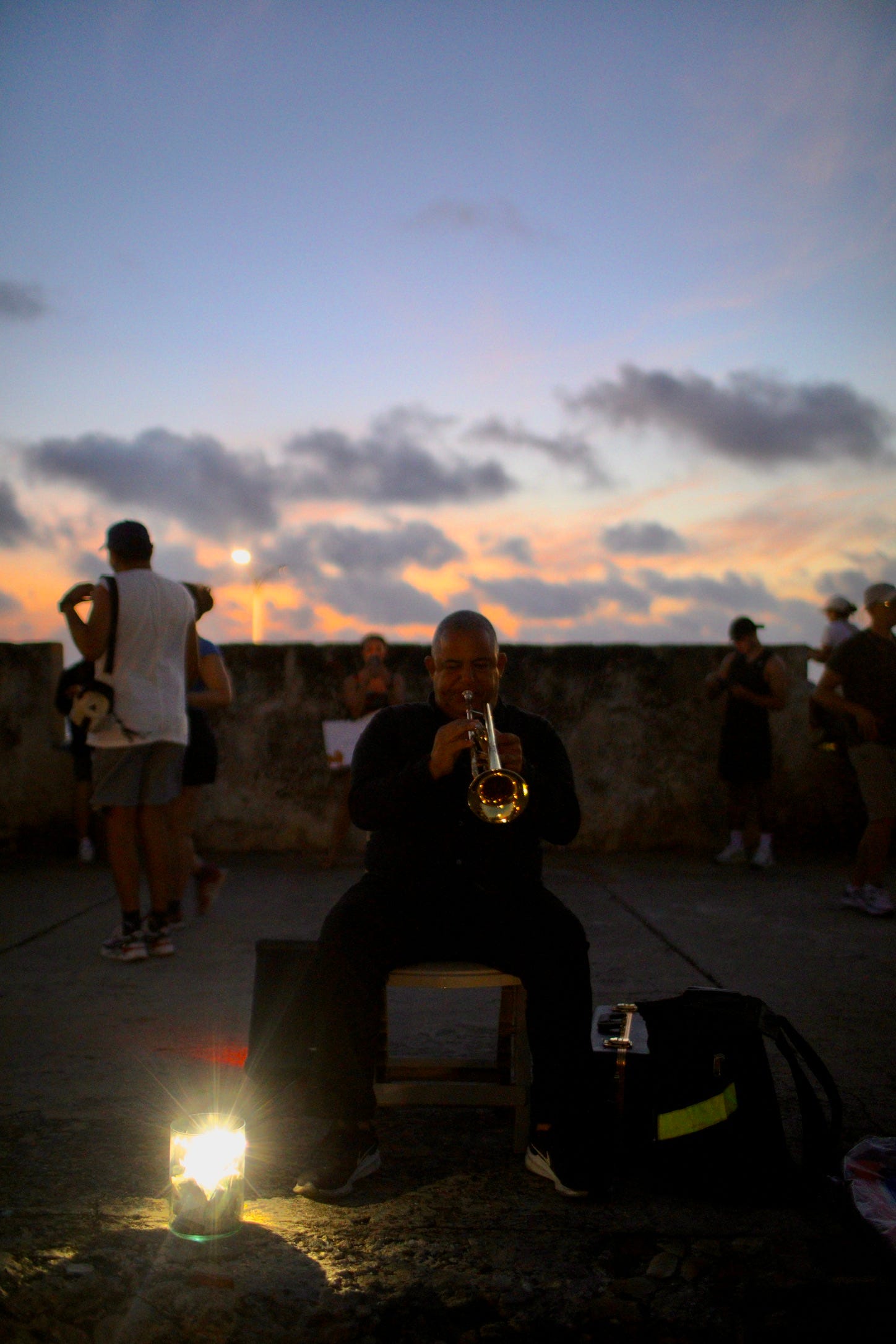
In Cartagena, Colombia, earlier this year, I sat on the old city wall in the setting sun, camera beside me on the wall, waiting. I had found a nice spot where the wall rose slightly, its crenellations glowing in the evening light, and sipped a beer while I waited for interesting people to walk by. Before long, an older man I had seen in the city centre a few times that week approached with a chair and a trumpet case. He set up directly across from me and started to play. The sun sank a little lower in the sky, and suddenly the scene was perfect. I lifted the camera, calmly snapped a few frames, then sat back down and finished my beer, listening to him play. I didn’t look at the camera to review the shots, but knew I had a great photo. I savoured that moment. The beautiful crepuscular world was filled with his tremulous notes and children ran up and down the wall, playing games I didn’t know the rules of. People ate from steaming food carts, danced to the music, laughed and sang and danced some more. And there was me, sitting happily, alive in the knowledge that I had learned a simple thing from one of the best photographers to ever live.
On Meeting Your Idols, Part One: Tokyo With Steve McCurry

It’s past dark in Tokyo but the air is still thick and sticky, the mid-afternoon rain having dispelled none of the day’s awful heat. Instead, the night is soupy. The long road I’m walking down smells of pine sap an…