

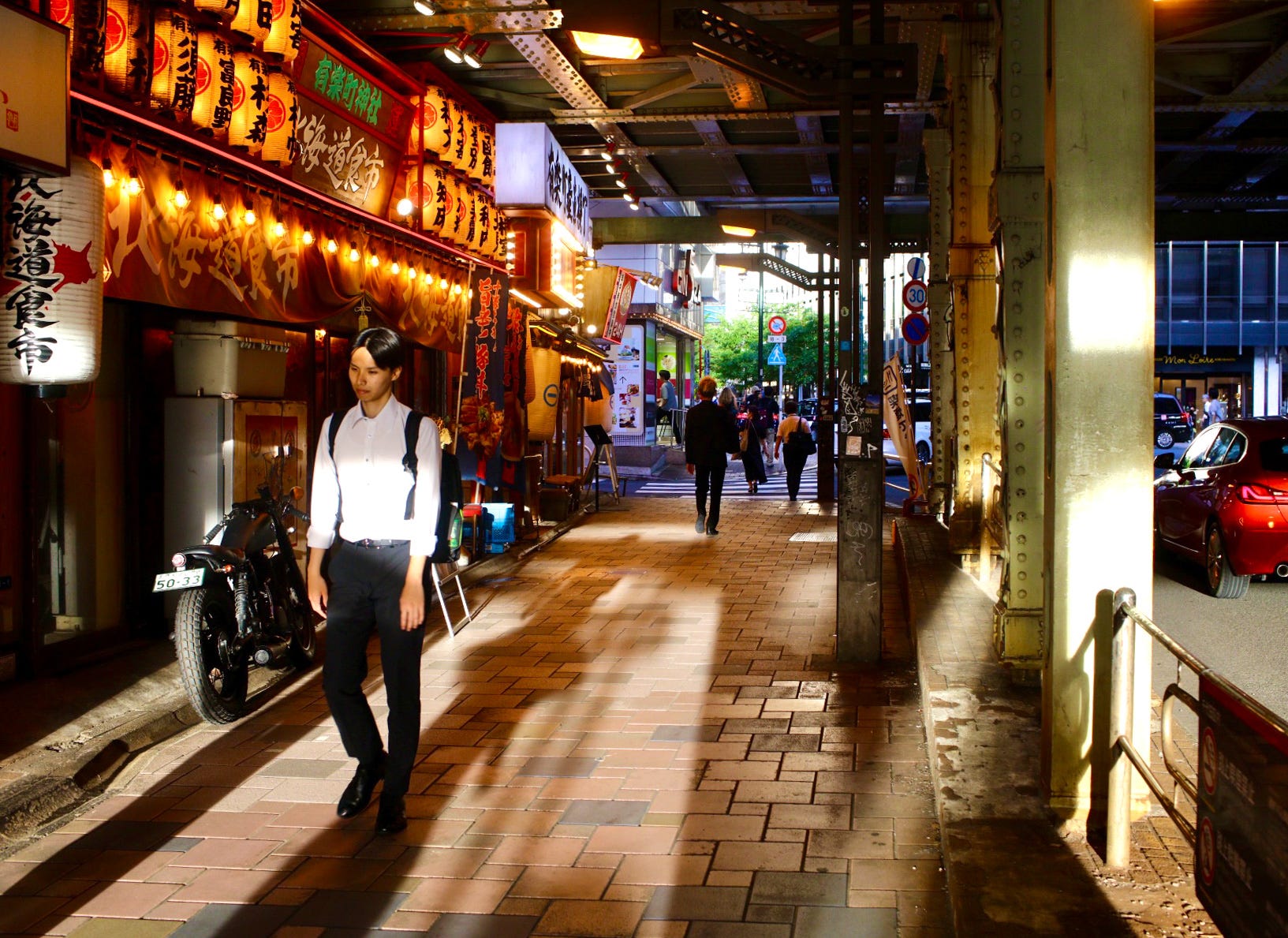
It’s past dark in Tokyo but the air is still thick and sticky, the mid-afternoon rain having dispelled none of the day’s awful heat. Instead, the night is soupy. The long road I’m walking down smells of pine sap and engine oil. There are few people around: some taxi drivers reading in their cabs parked alongside the road, a delivery guy napping beside his scooter in the grass, a couple playing badminton under a streetlight in the distance in some park I don’t know the name of. The chewy air hangs under the lamplights like a fog, slightly yellow in the weird halogen glow.
My shirt is already clinging to my skin. This is bad. I’m on my way to have dinner with 20 strangers that I’ll spend the next week with, and for once I’d like to not make a sweaty first impression. I slow my pace, but it’s futile. I need a better plan.
I come to a crossroads near the restaurant where I’ll meet the group in an hour or so, and find a cluster of deeply air-conditioned-looking bars that offer an immediate solution. I walk into the first place I see, which happens to be a rum-and-cigar bar with a live band. In typical Tokyo fashion, it’s a little strange and alienating. The four men sitting at the bar look like they’ve never sat anywhere else. They smoke Churchills with an irritating, effortless cool, they sip from big cups filled with mint and ice, they wear floral shirts under leather jackets, and surely they are part of a popular Japanese subculture I’ve never heard of. So this is the Havana Boys Biker Scene? Never have four people so perfectly fitted their surroundings. When my bourbon-and-tiny-cigar combo arrives, these men raise their glasses to me in unison, a well-rehearsed gesture that fails to put me at ease. Instead, I puff away in uncool contrast to them: hurried, nervous, lame.
It’s not them, it’s me. I am nervous. I check my watch, fogged in the air conditioning. In half an hour or so, I’m going to meet one of my personal heroes, the man that I’ve come to Tokyo for. I’m about to meet Steve McCurry.
Even if you don’t know the name Steve McCurry, you know his work. He’s probably best known for the National Geographic cover shot of a young Afghan refugee girl named Sharbat Gula, who Steve met at a refugee camp in Pakistan in 1984. It’s a gorgeous and subtly haunting photo: her piercing green eyes, her tattered red shawl, this innocent person looking at once scared and curious. It’s technically perfect, too. The contrasting colours are superb, the gaps in her scarf matching the green wall of the dismal tent. She’s startled, she’s temporarily safe, but she’s fundamentally lost. It’s the ideal photograph, and emblematic of Steve’s work. But it’s simply one of many perfect photographs he’s taken.
His career spans five decades and hundreds of thousands of rolls of film. My favourites of his photos are from China and Burma, where he captures a kind of essence that most photographers don’t. Look these images up. Or the ones of animals. Or his post-tsunami Japan photos. The monsoons in India. Any of it, really. He’s undisputedly one of the great photographers.
And as I smoked my cigar and sipped my whisky, he was waiting at a restaurant around the corner to welcome me and other photographers to his inaugural Tokyo photo workshop. We’d spend a week together, sort of, walking around in Tokyo and trying to create some nice images. I had been looking forward to this for years. It also terrified me.
This welcome dinner I was nervously await-avoiding would be my first impression of Steve and the photographer with whom he hosts these excursions, Eolo Perfido, a Roman with his own exceptional talent. I planned to be ever-so-slightly late because I was worried about being the first person there, but the punctuality of the group disarmed me. Five minutes before the dinner, I received panicked texts from the organizers saying, “Where are you?” I stubbed out my cigar, received salutes from the four cool dudes, and hurried the two minutes to the restaurant. I’m pleased to announce that my tactic worked and my shirt had dried.
When I walked into the restaurant—the inspiration for the Crazy 88s fight scene location in Kill Bill—that nervousness disappeared almost instantly. Our group had mostly arrived and were seated upstairs at two large tables in an area of the restaurant where guests are asked to remove their shoes and sit on the floor. Several pitchers of beer were already on the tables, and people were laughing and talking loudly. I quickly introduced myself to someone, who said, “Have you met Steve?” and then without warning I was shaking Steve’s hand and doing small talk with an idol. He was warm and friendly and said, “Let’s have a great week!” or “Glad you could make!” or something. That was it.
I had built that moment up for such a long time, for so many reasons. Rarely do I write anything about travel without mentioning Paul Theroux (undisputedly the great travel writer), whose books always featured photos by Steve McCurry. They travelled together (sort of, I’d learn this week; in my head, at least, they always travelled together). I remember the disbelief I felt when learning that they were connected at all—wait, the Afghan Girl photographer is the one who takes the photos for these books I love? In the same way that I equate Theroux with travel I equate McCurry with journalism. But tonight, he was just a guy having dinner, like the rest of us.
I sat at the end of the other table, across from Eolo’s assistant—by day a page in the Italian Parliament—and a couple from Seattle: Steve, who would be taking the course, and his wife, who was in Tokyo for the first time. Steve was quick to ask about gear and to identify himself as an enthusiastic amateur. To my right was Quin, a triple-retiree in search of Pokemon cards for her grandson, facts she repeated often. Quin had been a general in the US military and a university statistics professor (and a third thing), and she suffered no fools, she often said. Beside her was a young Malaysian guy, Xander, who Quin had adopted as a kind of pan-Asian interpreter. He patiently explained every item of food that came out, which she would then try and declare delicious. Xander lived in Bangkok and worked in tech as a project manager, and had a personality type I identified from my day job: studious and organized, an excellent listener and communicator. He also had a curious mind and a good sense of humour. I liked him immediately. Further down the table sat Ana, a ridiculously talented wedding photographer from Mexico, and Caio, an infuriatingly handsome Brazilian photographer living in Vancouver. I’d grow close to them both over the week. At the table with Steve and Eolo were four Colombian wedding photographers and a few of the spouses of the Italian crew that helped Eolo. The Italians never quite explained what they did, but from time to time would speak up in the WhatsApp group or share their location.
As an introduction to the two famous photographers, the evening was something of an anticlimax. But this was good for my nerves. A casual and low-key dinner ensued, pleasantries were exchanged, and pitchers of cold Japanese beer poured and refilled and poured again. The meal ended early, and we all shook hands and went our separate ways into the heavy night air. Wired and jet-lagged, I trudged back to the cigar bar, nodded with significantly more confidence to the Havana boys, and ordered a Churchill and some bourbon. I felt like I had earned a celebration.
The next morning, the celebrating weighting heavily, I bumped into Xander on the platform at Yotsuya Station. The workshops were in different neighbourhoods every day, so I had decided to stay in Okubo, just north of busy Shinjuku. I was on my second train to get to the kickoff session at the Leica Flagship Store in Ginza, so bumping into Xander was extremely unlikely, bordering on serendipitous.
As I wrote about in the introduction to this story, a previous version of me would have ignored this and waited to randomly see him a third time before assigning any significance to run-in, but 2025 me called out to him and we shared an awkward, sticky half-handshake, half-hug, then rode to Ginza together, talking about what excited us most about the coming week. We agreed that one of the highlights of this entire week would be what awaited us that morning: Steve McCurry walking us through his portfolio.
Both Steve and Eolo are Leica ambassadors, and the workshop had advertised that we’d been in the classroom at various Leica stores around Tokyo. The director of the Ginza branch greeted us in excellent English (he had lived in Rhode Island or a similarly pointless state for 10 years) and ushered us past the vintage cameras on the showroom floor to a classroom upstairs, where 20 uncomfortable but stylish chairs had been arranged in rows facing two armchairs and a screen. Since we had all been acquainted the previous evening, the mood was light and easy. People mingled, chatted comfortably, made bad jokes. The staff all wore black and came and went through sliding panels in the wall. It was all so futuristic and Japanese.
Before long, Steve and Eolo took their seats and the workshop began. Eolo—who would drive all logistics, coordinate daily sessions, and generally project a forlorn and tortured artistic aura—laid out the schedule for the day. We’d look at both Steve’s work and his work and try to grasp what made a street photograph good. We could ask questions at any time. We’d break for lunch, then learn some more. And then, that afternoon, we’d have our first session of shooting, something around Ginza, just to practice the basics.
We started with everyone giving a quick introduction, including a bit of their background as a photographer and the gear they’ve brought. My imposter syndrome immediately flares up. People explain their 20-year professional career, name $12,000 Leica cameras. “I’m a travel writer,” I gulp. “Canon 5D, mostly just a 35mm lens.” There are no follow-up questions; I’m safe.
Steve and Eolo gave a bit of their personal histories. Eolo is a portrait and street photographer who spends 6 hours every morning walking around Rome snapping black-and-white photos. He’ll later show off his portfolio, including his stunning in-studio portrait work, but on the first day of the workshop I have no real awareness of the depth of his talent. Steve tells his story in broad strokes. He studied filmmaking and then just took off to India for a year, where he made a name for himself as a photographer.
Backgrounds established, we move on to the thing I’ve been most excited about: Steve McCurry doing a slideshow. Steve has taken millions of photos, so he begins with a modest presentation of photos he has taken exclusively in Japan. The format is perfect. He just kind of advances through photos at his own pace, telling stories behind the images if something springs to mind. He encourages questions, but it takes us all a while to work up the nerve, pick our jaws up off the floor. His work is uniformly beautiful, but I’m personally surprised by a sense of humour I hadn’t noticed in it before. And a darkness.
Though something of an informal aficionado of Steve’s work, there was a lot here I hadn’t seen before, or even known about. Forget the monkeys who hang out in the hot springs or the girl in the kimono running down the stairs to catch a train: Steve had been in Japan—coincidentally, he says—during the tsunami and nuclear events at Fukushima, and I was seeing these pictures for the first time. There is so much good work, so many compelling photos. My favourite is one of a shipyard, but all of the boats have been lifted up placed back down at horrible angles, and walking amongst them is a person in a hazmat suit and their frail and tiny human body is perfectly placed in the frame between some of the boats, the wreckage, the end of the world, a few pylons toppled over, all that flotsam. This image makes me instantly reflect on my entire output as an amateur photographer. I feel insignificant and untalented. I have never viewed the world so clearly as this man has in a one-off photo, never had the vision or patience to compose a photo that tells this kind of story. But, hey, that’s what we were here to learn.
When the Japan slideshow is over, Steve begins showing some of his other work from around the world. There are so many photos from India, one of which is on the cover of a book from 1985 called The Imperial Way, by Paul Theroux and McCurry. I had found it on sale at an art gallery in Toronto a few weeks before coming to Japan, and felt that my time had finally arrived to ask an intelligent question. As a travel writer, I have only ever worked with a photographer on assignment once. Either I was expected to take photos to accompany a piece, or—more commonly—I would file the story well in advance of the photos being taken, and a local photographer would be dispatched with a list of sites to capture. This latter approach was common with in-flight magazines and the travel sections of newspapers (though more and more Canadian papers asked me to wear both hats and provide photos with any piece I filed). What I had always heard about Theroux and McCurry, on the other hand, was that they travelled together, and this book with a double byline confirmed that rumor. But I wanted to set the record straight, if only to myself.
“When you take photos for someone’s book or a magazine story, do you travel with the writer or do you get an assignment separately?” I feel good about this question. Steve immediately laughs, and I assume it’s a kind of winky laugh, appreciating my insightful question with my inside knowledge of the biz. That’s not quite right.
“Oh god, no,” he starts. He laughs some more. “On this particular book, the writer was Paul Theroux. He was on this trip with his wife and would spend all day writing at the hotel bar while I was lugging all my gear around, climbing up on roofs. Look: as a rule, the writer is always at the hotel bar, and the photographer is always the one doing all the heavy lifting.”
I laugh. Everyone laughs. It’s a great answer, a great moment. He’s so relaxed and unguarded, so casual and confident. He moves on through his slide show, out of India and into Afghanistan, where he spent a lot of time in the 80s. He shows a stunning photo of a remote and ruined village, where a family huddles around a fire in a building without a roof. It’s a very wide shot and a long exposure, and the effect is chilling. More breathtaking images come and go, and eventually he comes to the photo he’s best known for, colloquially called The Afghan Girl.
Everyone in the room nods, and a few hands shoot up. People have been waiting for this moment. “How did you meet her?” is the first question. “What about the controversy?” is the second. “What do you think of this photo?” is the third, and best.
The controversy question wasn’t intentionally broad, but its vagueness ended up being useful. There has been a lot of controversy surrounding the photo, which at its core is that of a vulnerable minor at a temporary refugee settlement. There are claims that Gula was angered by the picture, once she became aware of it in 2002. There are accusations of poverty porn and/or white saviourism, questions around consent, and a fascinating academic discussion around the aesthetics of suffering. The image is taught in university courses on photographic ethics. Not knowing which of these controversies the question referred to gave Steve a chance to spitball an answer that touched on various fronts.
He was reunited with Gula in 2002, after a decade-long search. Steve had made multiple attempts to locate her during the 90s, and it wasn’t until 2002, with a team from National Geographic, that a series of clues led him to her in her hometown in Afghanistan. She was identified through iris recognition technology, because multiple women claimed to be her and multiple men claimed that she was their wife. Gula had of course never seen the photo or known that she had been on the cover of National Geographic. Steve took her photo again and she appeared on the cover for a second time, and they have remained in close contact ever since. He provided financial assistance for her and her family’s Hajj pilgrimage and legal assistance when she was arrested in 2016 in Pakistan for using a forged identity card. In response to her arrest and international attention—the long hand of her National Geographic cover(s) fame—the Afghan government provided her and her family with a home in Kabul. More controversy. Gula has led a long and difficult life, Steve calmly but heartbreakingly explains. As he tells these stories, he has the look of a kind of sad parent, dismayed and devastated by the choices his child has made, desperately but quietly hoping for a better outcome.
Okay, sure, but how does he feel about the photo? This question brightens him up considerably. He explains that he had been in the area for days, aware of the tent being used as a school for girls. He had stopped by previously. One day, he asked the teacher if he could take some photos, which was acceptable with children in a way that it wasn’t with young Afghan women. He was struck by the green eyes and red scarf of Gula, which he liked for their contrast. He liked the light in the tent. He liked the green wall and the green eyes and the red together. He explained that he always looks for contrasting colours, so chose to take her photo for mostly this reasons. Gula kept covering her face, but the teacher coaxed her out of her shyness. Eventually, he had what he thought of as a perfect shot: compositionally perfect, vaguely representative of a time and place. He was a photographer before a journalist, he explained with a laugh. And then he explained, so candidly, something I’ll never forget:
“People have taken this photo to mean so many things. But remember this: she’s a kid. I’m a strange man. She doesn’t know me, we don’t have a common language. I’m sticking a camera in her face while she’s at school, and her teacher is there trying to calm her down. People see things in her eyes. I see a little girl who is confused about a strange man and a camera; I don’t see a person contemplating the fall of a nation, an invasion by a foreign power, the loss of home. I see a confused little kid.”
I love this answer too. I suppose I had never really thought of the girl on the cover of a magazine in the 80s as representing a regime change or repression or anything in particular, but I was a kid too the first time I saw it. What I love especially in the context of this week, geared as it is toward exploration and learning, is the rawness of the answer, of the simple truth it contains. He saw the right colour combination, the right moment, after a week or so of being in the region and not finding the shot. But he knew it was there somewhere, so he kept coming back.
This, I believe, is the secret of his work: time and patience. People say right time, right place—but I think for Steve it’s more about right place, and just allowing for time to pass and pass and pass.
And so eventually we hit the streets of Ginza, inspired and raw. The group has spent the day looking at some of the best street photography ever taken—both Steve’s own work and all of his historical favourites, especially Henri-Luc Besson, at whose apartment Steve would crash whenever he was in Paris for a Magnum meetup—and then we were set free to experiment and explore and feel inadequate. The real photo sessions would start at the famous Shibuya crossing in the morning, so this afternoon was meant to be a low-stakes waddle around what isn’t an especially photogenic district.
We all started as a clump outside of the Leica shop. The brief was simple: get to know your equipment, read the light, try to get some unposed portraits of strangers, and, if you were feeling brave, one posed portrait of a stranger. The idea of the workshop was to have these kinds of daily touchpoints with each other at the start and end of each session, but to shoot alone. This makes sense. It’s hard to be inconspicuous as a group of 20 people with big camera kits, and anyway photography is a solo endeavour, all about how you specifically see the world. Other photographers around are a distraction and an influence, we were told. But on this first afternoon, in test mode, we walked down one of Ginza’s polished streets as a huge gang, unsure of where or how to get started.
It was more of a social event than a photography session, at least at first. I chatted happily with Caio, Ana, and Xander, while we all looked around for some ideal subject. Steve and Eolo were half in host mode, half in photographer mode, Eolo more so. Here was the first practical lesson: neither held their camera in their hand. Steve had his hanging around his neck and Eolo’s was dangling loosely from his wrist. There was no urgency to their movements. They were chatting along with everyone, but their eyes were flitting around constantly, searching. Eolo snapped into action first.
In a garage behind a restaurant, a teenager with a stereotypically Japanese haircut is having his smoke break. He has a kind of chopped bob, very 90s anime, and his white shirt is buttoned all the way up to his throat, but is stained wherever he wiped his hands, which is everywhere. Eolo clocks him before anyone else and immediately zeroes in. The kid is lost in his phone and his cigarette, and Eolo gets right up to him—within 8 inches of his face—and starts snapping away. We knew from earlier in the day that this is his technique and his strategy, to get in before someone notices and then to ask them later for permission. He gets a few shots before the kid even looks up from his phone, then nothing really changes. Eolo says something in English and the kid laughs and goes back to whatever he’s doing, and Eolo keeps going. This is a smooth and easy outcome to his approach, which he insists can always get his subject onside.
Across the street, the rest of us are aghast. I look at Caio, who mouths the word “unbelievable.” Ana says, “He’s fearless,” then laughs her addictive laugh. None of us will admit this, but we don’t yet possess this quality, this fearlessness, and it makes us worse as photographers. We need to learn to be in peoples’ faces. That’s another point of this week. Standing in that uncomfortable knowledge, we instantly disperse. We’re emboldened and feel like a gauntlet has been thrown down, so off we go to get in some faces.
I’m terrible at this. There’s something especially uncomfortable for me about getting into the faces of Japanese people, who I know to be reserved and private. I think part of the reason that Steve and Eolo chose to do this workshop here is because the Japanese are too polite to say no to this style of intrusion, and so it’s very easy to get up close and personal. If people are uncomfortable, they’ll never say so. More or less.
I chicken out on the up-close portraits, at least for the first day. Instead, I spend two hours in the blistering afternoon heat trying out another of the day’s lessons. I find some nice light, some good backgrounds, and compose my shot and wait for someone interesting-looking to walk through it. The results are mixed. Every shot looks lazy or uninspired, and I feel self-conscious and hacky. The people are too far back in all my shots, and it shows how afraid I am to get close.
The area in Ginza close to the Leica shop is small, so everyone in the class keeps bumping into one another. I see Ciao bravely asking a shopkeeper if he can take her portrait. He snaps a few frames and then looks at me and shrugs to say “I haven’t got it yet.” Ana is nearby, sneaking up on two smoking businessmen in front of a bright mural. She sees me and waves warmly, then gets back to work. Later, I see Xander leading Quin back toward the Ginza metro stop, he smiling patiently and she saying loudly, “I have absolutely no idea where I am!” He laughs gently and shoots me a knowing look. It’s all so friendly and sweet.
Eventually, I tire of taking mediocre photos and slide into a stool at a bizarre Basque bar in a little alleyway. The two young Japanese bartenders seem surprised to have a customer, and I order a txakoli and a gilda and forget where I am in the world for a little while. I review the photos I’ve taken for a few minutes before Ana texts what over the week becomes a customary “where are you” message. “Dinner?” she follows up. I walk back toward the main road and find her and Caio, and we wander through a crowded laneway until we find space at an izakaya for a beer and some snacks. Our cameras are all on the table, and we’re chatting while reviewing the day’s shots. When we see something we like, we turn the screen to the others, who offer a live critique and ample praise. And so a routine is established: after every session, we meet nearby to cool off and share our work. I’ve never been surrounded by other photographers like this, shooting and sharing all day, every day. It’s intoxicating.
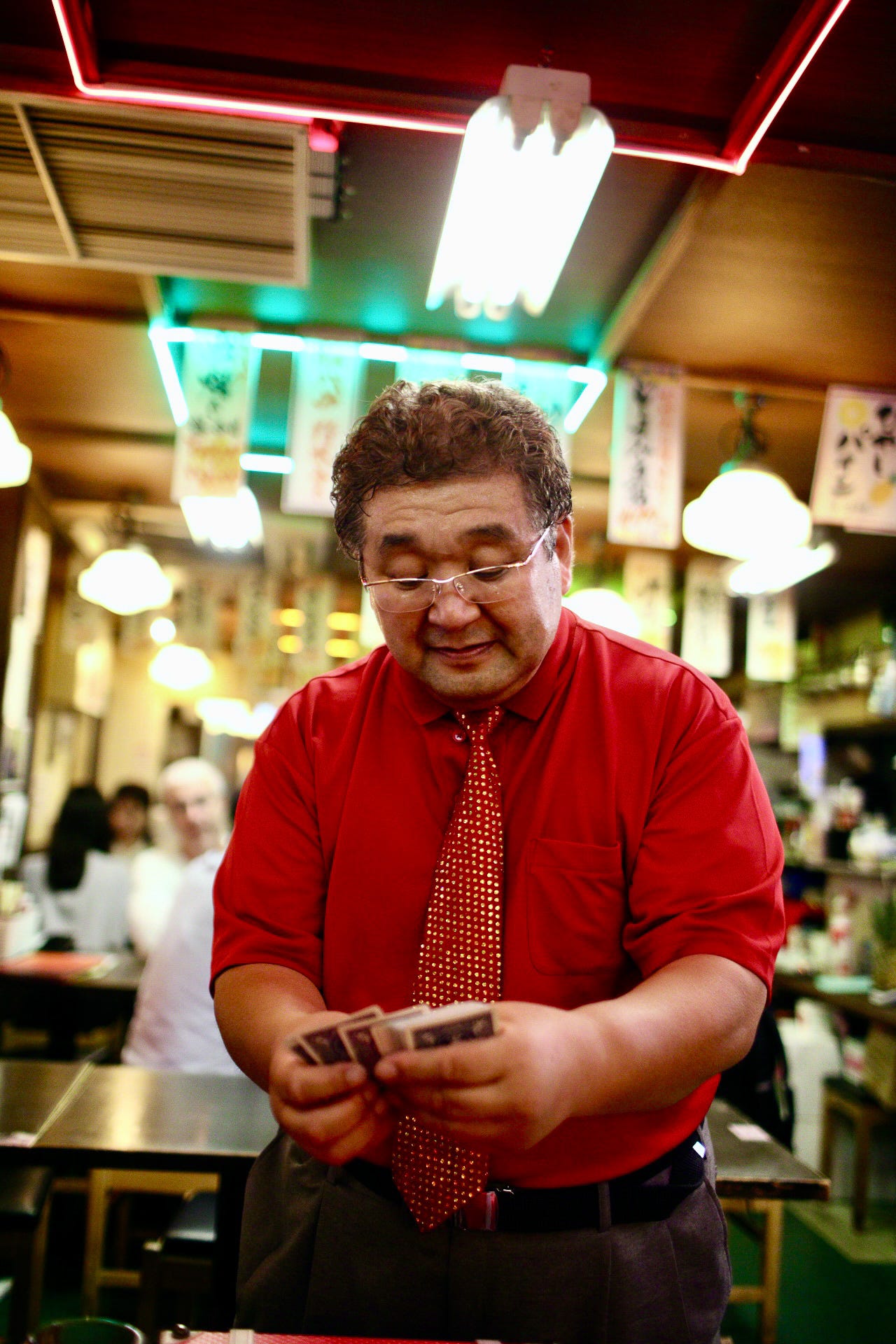
In this relaxed and encouraged state, I get my first good photo of the trip. A strange man with a floppy briefcase approaches our table, wearing a red shirt and a red spotted tie. His shirt is bulging at the seams and struggling to remain tucked into this belt. He has a kind of curled short perm. This is all quite unusual for Tokyo, but he soon provided an explanation: he popped open his briefcase and took out a deck of cards. Of course. He’s a roaming magician. He hovers over our table for a few minutes, doing card tricks in Japanese/pantomime, and all the while I’m able to take sneaky shots with my 35mm lens. This is my wheelhouse. When he’s done Ana accidentally tips him $50, and soon after we are scolded by the restaurant staff for drinking some mezcal she has brought with her and is pouring generously into our water cups. Before long, we head our separate ways into the steaming night. It’s not too late, and we have an early start the next day at the busiest intersection in the world.
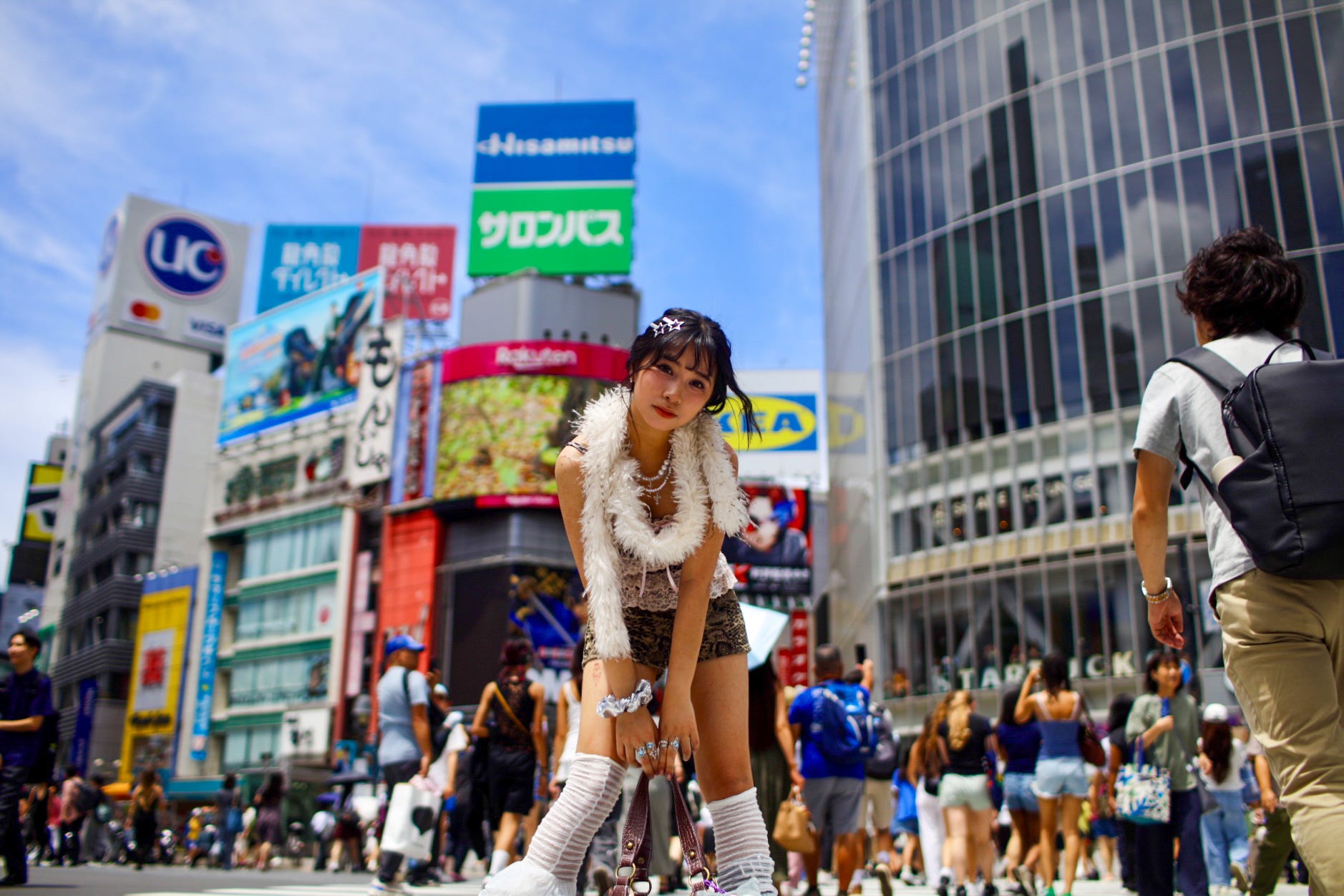
The next morning, our whole group waits sweating in the shade of the only tree at the Shibuya crossing. It’s already 9 a.m. and the day is scorching, the heat unforgiving. Shibuya is one of Tokyo’s largest commercial districts and the pedestrian crossing outside of the train station was made famous by Lost in Translation and has featured in other iconic films like … Sonic the Hedgehog 3. As many as 3,000 people cross the intersection in a single green light, and when it’s raining and nighttime and all those people have transparent plastic umbrellas that bounce up and down as they cross the street, the scene is nothing short of magical. This morning, with the morning rush hour over and the temperature in the high 30s Celcius, Shibuya is unusually quiet. A few campaigners for the upcoming election shout half-hearted appeals to the few passersby, but otherwise the area was sleepy and overheated.
Steve and Eolo gave the morning briefing and offered two options for the next few hours: Steve would head off to some back alleys and Eolo would work the crossing, each with different goals as part of today’s checklist: a posed portrait, a reflection, sometime geometric (preferably triangular), a figure in isolation in a busy world, etc. Eolo points out a rooftop bar with an entrance fee, and Steve mentions something about the light in a couple of hours. And then we disperse.
Even on a quiet morning the crossing is pleasantly chaotic, with people going in all directions from the five streets that meet here. The crossing itself only takes about a minute, and then there’s three or four minutes when everyone lines up for the next light to change. The photographers can be seen on all sides of the crossing, stalking behind an interesting person, readying themselves for the next rush into the street. I enjoy this so much: wandering around in the heat, camera hanging from one hand, looking for someone with a unique outfit, a particular way of standing, a spectacular hat, anything. I’m spoiled for choice, here, with cosplay teens and hungover salary men and hunchbacked women carrying heavy shopping bags, and what’s more is I love this style of shooting. I take most of my pictures underhand, knowing what the lens is seeing from years of taking sneaky portraits. I love the angle and depth of the 35mm lens hanging just below my hip, the sense of movement it creates. It’s how I’ve been taking photos for nearly 20 years, and I’m comfortable with and good at it.
But after an hour, I realize this isn’t the point. I’m not here to be comfortable doing what I’ve always done, so I force myself away from the crossing to try to do my homework. I find some eels languishing in a tank in a department store window and try to compose reflected shots as per the instructions. I look for triangles. I follow lone figures around from a distance, trying to take a photo that shows their loneliness, the scale of the city. After half an hour, I’ve absent-mindedly drifted back to the crossing.
It’s nearing lunch time, and getting busier. I have some hairbrained idea about a shot from above, so find the rooftop and pay the entrance ticket and get the free beer it comes with, then chat with a Canadian couple who are marvelling at the madness below behind a plexiglass partition that ruins all of my photos. I’m only carrying wide-angle lenses, so I run out of shots I can take after about 10 minutes, then head back to street level.
There’s a kind of mania now. It’s properly busy and hundreds of people are queueing on each side to get to some spot for lunch or to the train. I wait at the busiest corner, ready for action. This mostly involves scanning the crowd around me for a new subject every time the light changes, and if there’s no one interesting, scanning the crowds on the other corners. If the person is on the same corner as me, I get ahead of them and walk quickly into the middle of the intersection then turn around and look for them. If they’re on an opposite corner, I walk slowly toward them, waiting for the scene to unfold. I hold my camera up to my eye like a proper photographer instead of trying to take my standard sneaky underhand shots. I look not just for triangles, but at the geometry of everything: the lines of the crosswalk and the towers behind and the arc of an umbrella nearby or the crooked swoosh of a dress in a sudden gust of wind.


It’s probably my favourite session of the week. My style is better suited to this light, to the chaos. A few other people from the workshop are back at the crossing and we’re all kind of using the same technique of chasing people from corner to corner. It’s frantic and hilarious to me. We’re all adult professionals on an expensive holiday trying to closely follow people around a city that they live in, frivolously spending a day trying to show how weirdly a normal person here lives their normal day. It’s preposterous and fun and therefore so, so funny to me.
I see Eolo doing his lazy walk this way and that. He seems mostly unmoved by the scenes but carries on with crossing at every green light, which also cracks me up. He’s so used to creeping along behind strangers that nothing in this crazy place is speaking to him. I see him raise his camera once or twice, but he never shares the photos, so they must not have been very good.
Eventually, the heat saps us all, and the group disperses. I eat some noodles and Ana messages me to tell me she’s along nearby Cat Street with some others, so I wander over to sit in the heat and drink American beers with her and the Colombians while we all charge batteries in a nest of extension cords outside a Texas-style barbecue restaurant. We hand our cameras around to offer a live, in-person review of each other’s work, and this time I’m not really embarrassed. I know I got a few great photos, and take quiet joy when someone says “Wow” and tilts my camera to the person sitting beside them. I say a few wows of my own, all genuine. These people are so good at this. They are professional photographers, after all, specialized in weddings but technically gifted and with such an eye for a scene. Sharing these beers in this heat feels so familiar and comfortable.
When everyone leaves to head back to their hotels for mid-day naps, I carry on along Cat Street, looking for more interesting scenes. I can feel a change already in the way I move along with my camera, which dangles from its strap by my side. I’m no longer hurried. I scan the street for an interesting background and find a few, waiting for someone interesting to go by. I peek into shops to see if anyone looks interesting, I start to ask people if I can take their pictures. I seek good light.
The lessons are starting to sink in, my brain is starting to rewire. The pattern of shoot-rest-share-shoot-rest-share forces so much reflection and self-critique in ways I’m not used to and I’m already getting addicted to it. I can’t wait to find an air conditioned spot to look back on photos, to start to edit. I’m seeing myself get better in real time; another intoxicating feeling. I’m always ready to get back out and shoot more, if only to then want to get back in and review more, share more. It doesn’t feel manic, but rather calm, easy, controlled.
I keep walking northward toward Shinjuku, where we’ll meet for that evening’s session, back in my favourite Golden Gai. I notice that all urgency has drained out of me. Whatever awaits me—that evening, this whole week, the rest of the summer, the rest of the year, whenever, always—will come and will go easily, and I will move toward it and through it just like this, slowly, slowly, slowly.
***
Dog Cat Come Here

I’ve been here before, and a lot of it feels the same. For one, the feelings are the same. Or the exhaustion-driven emotions are the same. I am bleary eyed and overly warm and I have this strange sense of hurry, a need to make up for the lost time after basically a whole day has b…
See you in the car- Geeg.
LOL.
Well done, great to know it went so well - with lots of panic and truly learnt something!