

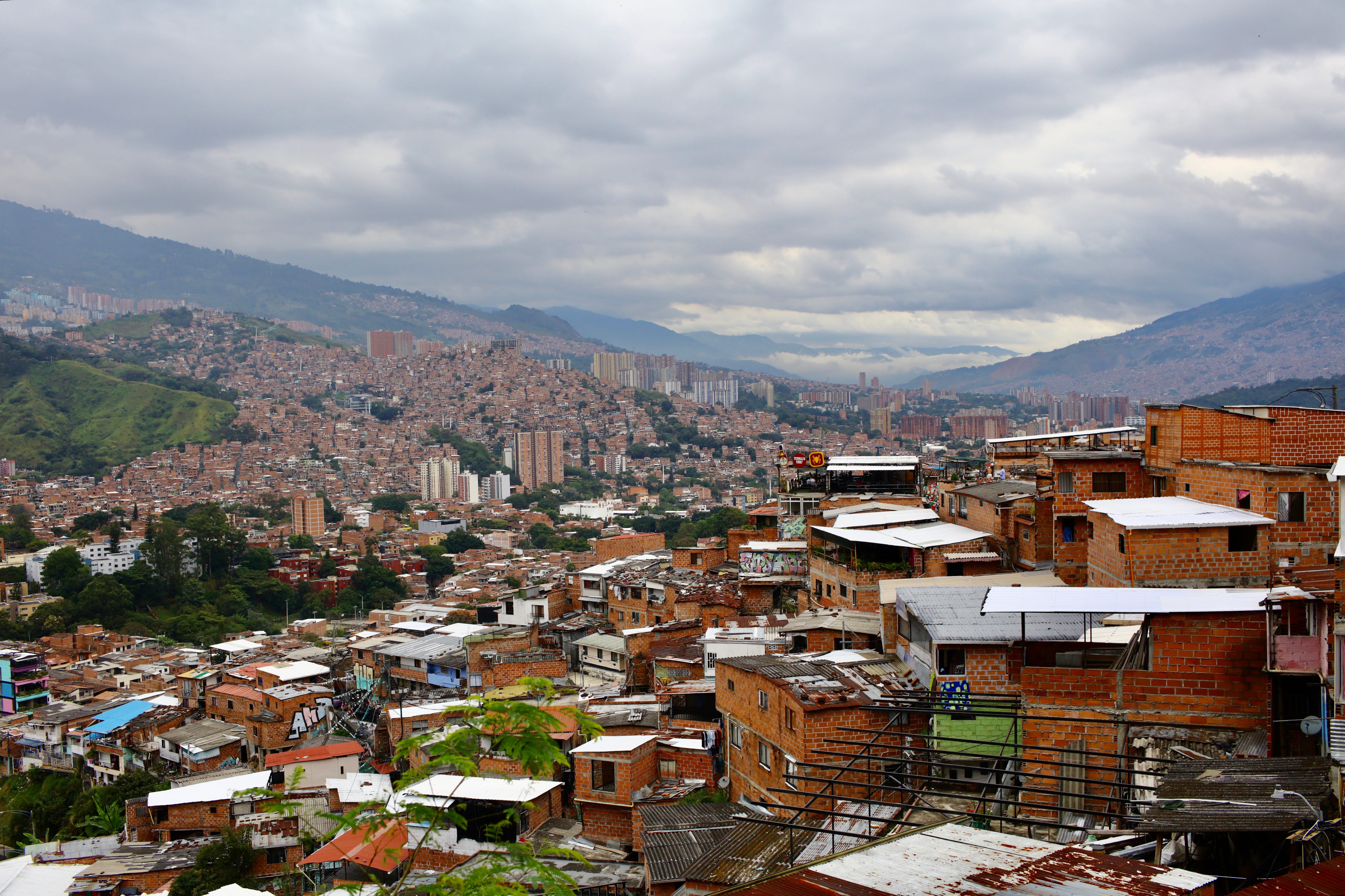
From up here at the very top of the mountain, the staggering size of this neighbourhood becomes clear. A city-within-a-city unfolds beneath me, ramshackle houses stacked on top of each other, spilling down the valley, and the neighbouring valley, and the next, onward toward the rest of Medellin. Most of the houses are simple unpainted rust-coloured brick, the roofs various colours of corrugated metal, many rusted to match the brick. Far below I can see the new school, and farther still the San Javier Metro, the sort-of-centre of the sprawling and chaotic Comuna 13, which was until very recently the most dangerous place on earth.
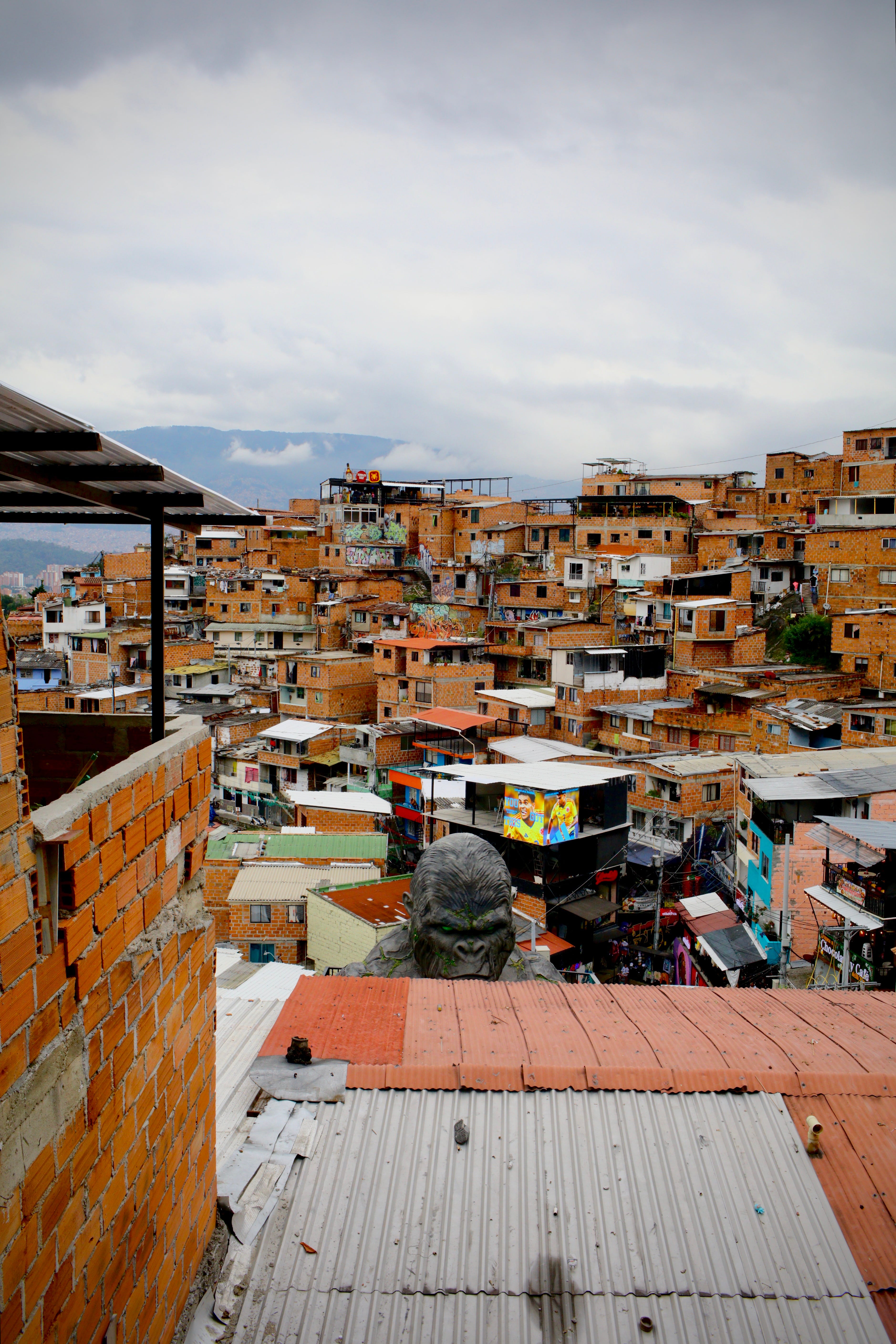
So claims my guide Juanjo, who was born just beneath where we’re standing, in one of the deep folds of Comuna 13. From the lookout, which is really just a sidewalk beside a few small shops and a house where a woman is hanging wet laundry over the banister of her stairs, Juanjo is pointing out what he considers to be the most interesting things about his district. He is very proud of the aforementioned new school, wary of some of the newer rooftop bars with their gaudy statues for selfie-seekers, but for the most part he talks non-stop about the two most important features of Comuna 13: the mass grave and the escalators.
At the beginning of the tour, somewhere out of sight far below, Juanjo began to weave a narrative that connects the two. We’re standing beside a fenced-in cement futbol pitch in a little gully that forms the intersection of three large sub-districts. In the 90s, when Juanjo was still a young child, the invisible boundaries between those three neighbourhoods were ruthlessly enforced by the three rebel groups that controlled their respective areas. He says that 8-10 people were killed each day in Comuna 13 in the 1990s and early 2000s, many of them right here where the futbol pitch now stands. Today, elderly women stand chatting idly, a taxi lingers waiting for a passenger, and chickens and turkeys roam around a muddy playground strewn with trash. It’s a normal place, if a little run down. But it’s safe. Most, importantly, it’s safe.
Juanjo attributes that safety to the outdoor escalators that connect the highest, steepest parts of this side of the comuna. On the other side of Comuna 13, Medellin’s famous cable car public transit takes commuters from the metro station to the top. But Juanjo is from this side, and he doesn’t care about the cable car. For him, the escalators are a symbol.
The other symbol: a salt mine in the hills far above the district that fell to disuse in the 90s and was used as a place of mass burial for people killed during Comuna 13’s most violent year. In 2002, in an attempt to crack down on guerrilla forces in the area, the Colombian government—with the support of the US, whose shadowy tendrils reach deep into every Colombian crisis of the past 50 years—sent the military into the area, with soldiers promised a bounty of about $100 USD for killing a guerrilla soldier. The accounts of the year that followed are varying and conflicting, with the government claiming as few as four civilian deaths and locals claiming that more than 1,000 bodies were buried in the mass grave. The bodies belongs to average citizens, usually young men, who would be shot and then dressed up in the outfit of the guerrillas and then handed in for a bounty. Juanjo’s family lost two people in this way, and everyone he knows lost someone. Only 50-some of the victims been identified so far. The mine is visible from almost everywhere in Comuna 13, greenish grey and looking down on all these houses, the new school, the escalators, the survivors.
For some reason, the narrative of this tour is rankling me. I can’t put my finger on it, but I’ve spent the first hour feeling slightly annoyed, mildly uncomfortable. Part of me—the intellectually lazy part—booked a tour so I could go to a picturesque neighbourhood and snap some nice photos of local people living local lives, looking photogenic. I pictured graffiti and rooftop parties like Anthony Bourdain found in Comuna 13, impromptu cookouts and everyone getting warmly adopted by the neighbourhood. Instead I’ve found an important history lesson, a survivor of a massacre, darkness. I keep trying to shake off the feeling of discomfort, and keep failing.
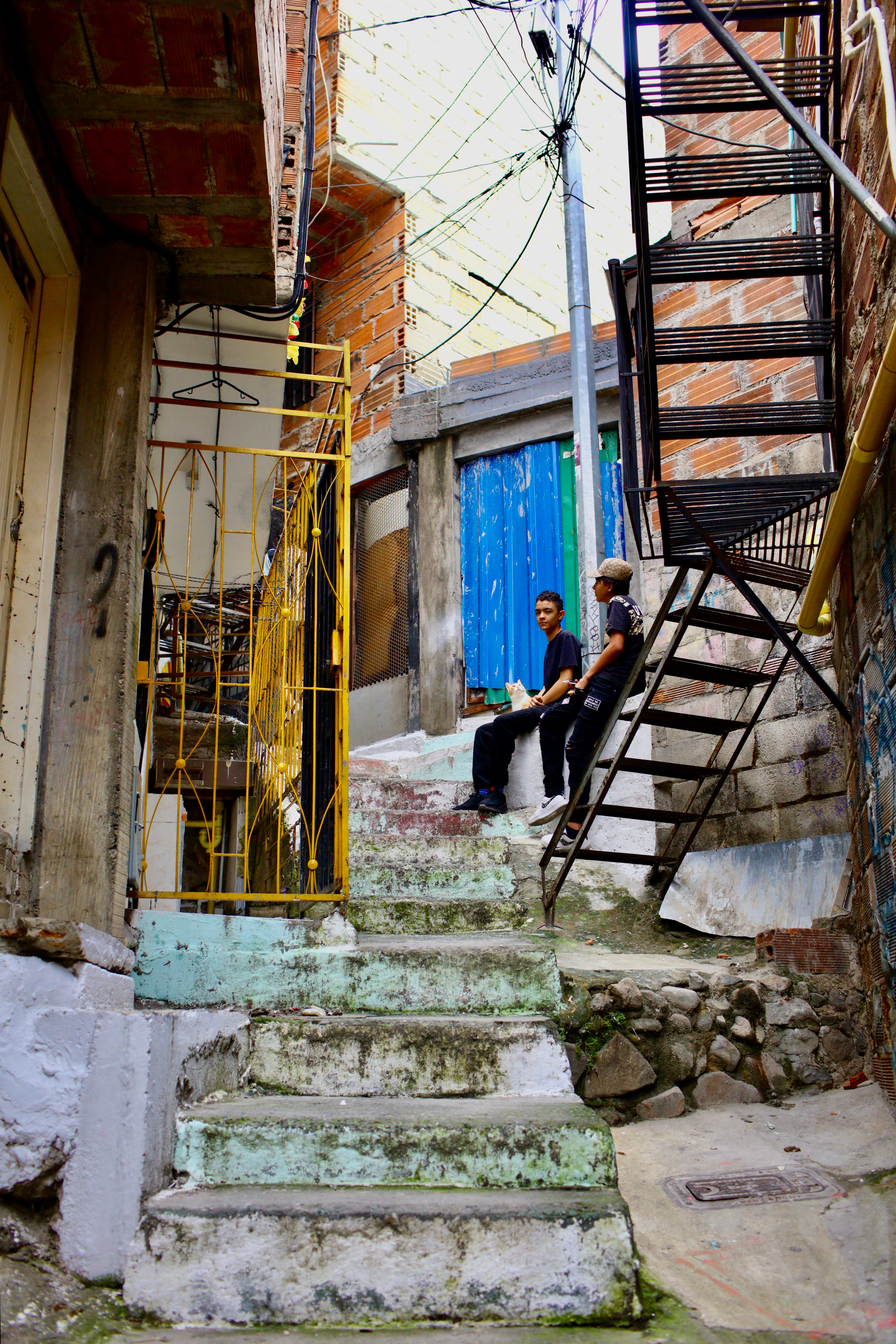
We begin walking up from the soccer field, past the small, muddy playground where some chickens and a turkey roam freely. The going is steep, and it’s easy to feel out of breath in the altitude of Medellin. I gaspingly keep up with Juanjo, trying to learn more about his childhood. He tells me how he used to walk to school from the top of the barrio down to near the metro station, but not on the paths we’re standing on now. He took the backroads—though not really roads, more narrow stairways and alleys passing between the houses; there were thousands of these routes up and down Comuna 13—because the direct route skirted too close to that deadly invisible line. We take the direct route going up, and for a brief moment I see a kind of wonder flash across Juanjo’s face as he looks to the right, across that old boundary. How free he seems. He sees me watching and points to some running water, then says, “Our small river! Look, see how those houses there are still made of wood.” He looks behind for the others on the tour. “Is everyone doing okay?”
We stop in a field where locals are walking their dogs, a few kids are playing. There’s a huge grey building, kind of brutalist, with fenced-off staircases where mice are scurrying about. This is the new school. It’s huge, but empty today because of the Christmas break. The walls are plastered with posters in English and Spanish, and Juanjo brings us nearer for a closer look. One says “Todxs sabemos quien dio la orden” (we all know who gave the order). Another: “Todo rio es sagrado” (every river is sacred). “Colombia stop war” in English. And another in English that Juanjo wants to discuss:
“Mariscal Military Operation happened in 2002. But the crimes remain unpunished in Comuna 13. We don’t forget.” Beside this another that says “But the victims continue to resist.” Juanjo stays silent for a minute, his eyes searching our faces for comprehension. He looks up into the distance at the salt mine. “Who wants to see the only outdoor escalators between houses in Latin America?” he asks with renewed enthusiasm. I keep watching the mice run up and down the stairs of the school.
We walk a little further up through wide, paved streets. Medellin’s ubiquitous charming green buses chug up and down the street. The security guard at the school smiles widely and yells a good morning from behind a barred checkpoint. So many people are out walking dogs, many of which are cute, few of which are on leashes. How free they all seem.
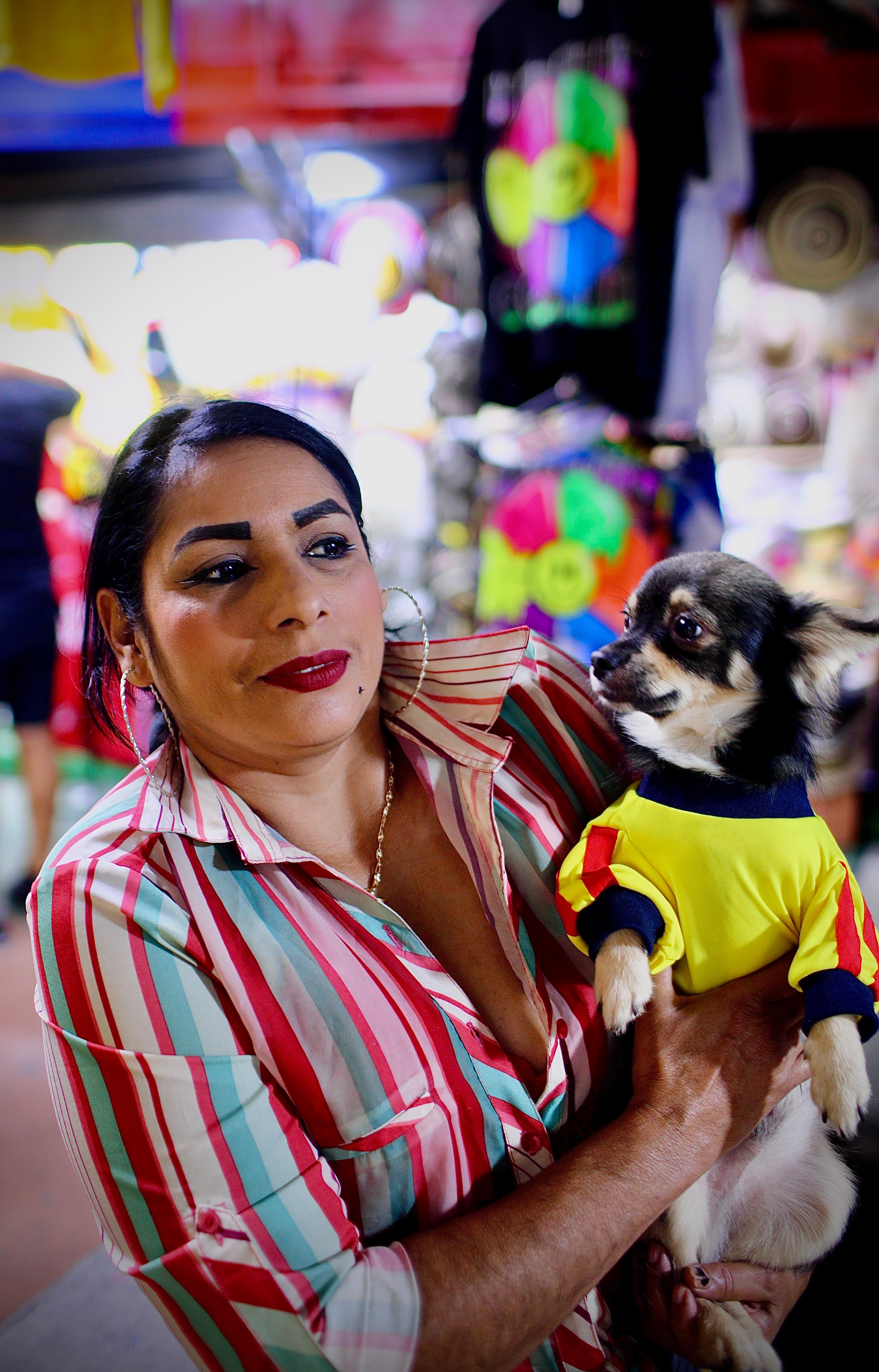
Before long we’re in one of the busy, really touristic areas, the end of the roads and the start of the staircases and near-vertical alleys at the top of the district. There’s a kind of long vendor-lined walkway with all the standard tourist fare: Colombian soccer jerseys, magnets with Pablo Escobar’s image, knock-off luxury bags, pot brownies, prints of the local murals and graffiti. We politely decline our way up this alley and then head for some stairs. The lanes get more narrow (though still vendor-lined) until we reach a small opening where 40 or so chairs have been set up in front of a dance troupe. The lead dancer is addressing the audience entirely in English—”We need some energyyyyyyyy!”—and the crowd cheers. The dancers are really, really excellent; it’s a mix of choreographed moves and then break dancing and acrobatics. There’s a guy who can dislocate his shoulders and gets twisted around ridiculously as part of one routine. Everyone is laughing and cheering, and then the hat gets passed around for donations, I give happily.
And then we finally come to the main event: the escalators. Juanjo has been hyping these all day, and pauses one last time to build the tension. “We will take escalators two through six. You should follow the rules of the escalators. No running or even walking. You should stand and let the escalator take you up. Those people in the grey uniforms are there to make sure no one is walking on the escalators. This is for your safety and everyone’s safety. Let’s go!” This last is said with more enthusiasm than I’ve felt for anything in my life. We go.
It’s much like you’d think: standing on an escalator. They move at the normal speed that escalators do, past bars and shops selling T-shirts and drinks. At each landing between escalators, vendors swarm to offer micheladas or hormigos—fried “fat ass ants,” according to one sign that are said to be (according to that same sign) an aphrodisiac. On the third or fourth escalator, I find myself alone with Juanjo. “Have you ever been on an escalator outside that goes between houses?” he asks. He’s beaming. I tell him about the escalators in Hong Kong, how they take commuters up through Central during the day and then back down at night, how the whole thing changes directions. He looks crestfallen, and I feel terrible. I don’t know why I’ve said it.
“But do they go up and down at the same time?” he asks, finally.
“No! They don’t! That’s right.” I reply, and he brightens. “And they don’t go between houses,” I add.
That’s right!” he says. “They don’t go between the houses.” He smiles broadly and looks around, then nods happily. They don’t go between the houses.
We stop for coffee and visit a couple of galleries. We have a frozen fruit thing that is delicious and refreshing. We walk down the tiniest of staircases and end up back at the bottom of the escalators, standing on the patio of a closed empanaderia. Juanjo arranges us in a circle around him, and begins his final speech. “At the start of the tour, I told you I would tell you one big surprise when we finished. Here’s the surprise.” He gestures at the building behind us. “This was my house where I lived. Here, at the bottom of the escalators. But we didn’t have them then.”
This is the moment when it all clicks into place. All day, he had been explaining that the escalators were the reason that the violence ended, and I didn’t understand it. Under that green-grey shadow of the mass grave, the escalators seemed to me trivial. To me, the violence ended and then later the neighbourhood added escalators. And after the escalators, the kind of typical tourist trappings found anywhere in the world. I saw only mundanity and overdevelopment, but failed to understand how significant and life-changing mundanity, with all its calmness and safety, can be. No wonder Juanjo was so transfixed by the idea that these escalators went between houses, including his childhood home. People live here, have survived here, and now they have an easier way of getting around. They aren’t looking over their shoulder at each new sound, or worrying where the lines have been drawn by the men and teenagers with their automatic weapons. How free they all are.
Loved every second of this, and great photos too.
All that build up about the escalators and I had to Google image search them.
I'm with Juanjo they are cool!